Physical Address
304 North Cardinal St.
Dorchester Center, MA 02124
Physical Address
304 North Cardinal St.
Dorchester Center, MA 02124

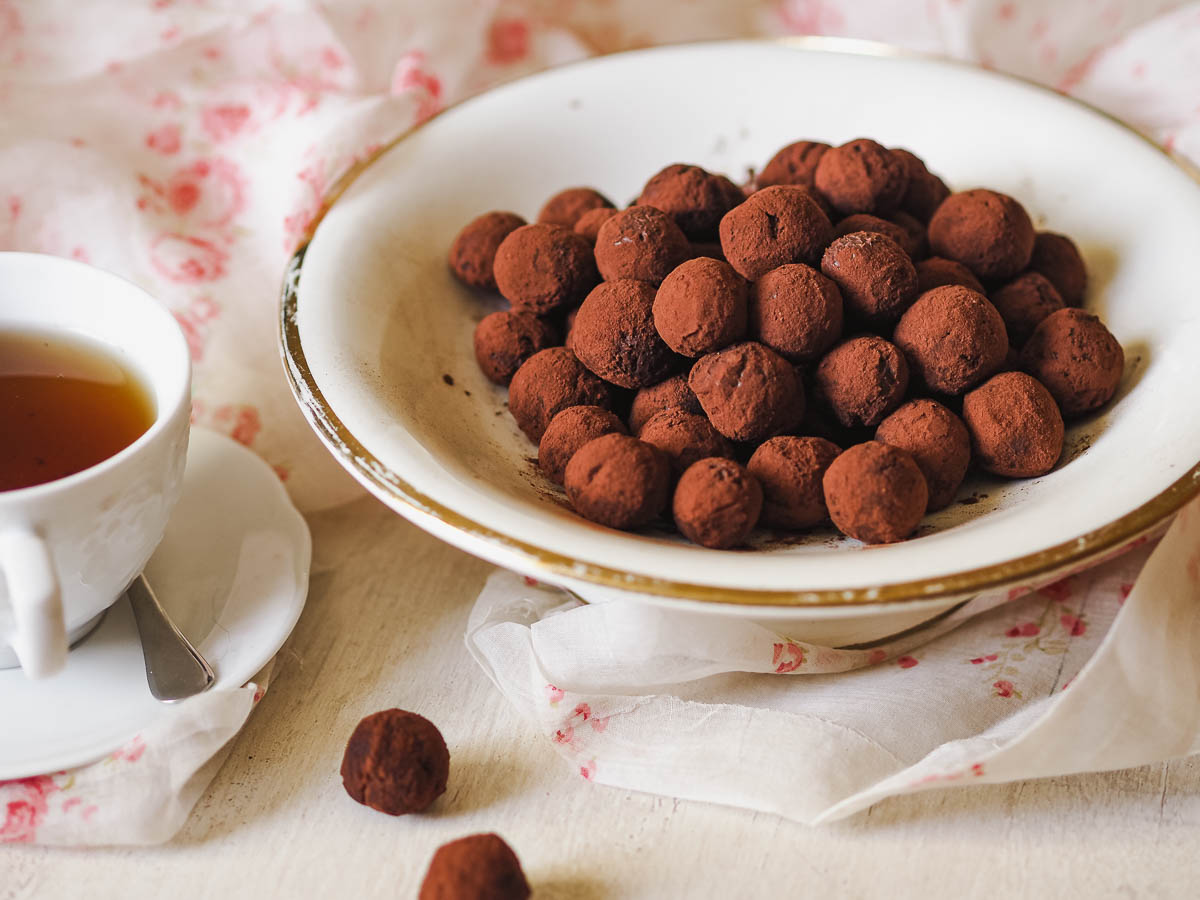
Chocolate truffles are truly synonymous with Christmas, to be made at home all year round because they are so easy to make.
Here is my best recipe, the story of its origin and lots of advice.
The truffle is a Savoyard invention from the end of the 19th century.
It is Louis Dufour, Savoyard confectioner based in Chambéry, who is considered the creator of the true chocolate truffle.
We find traces of it in advertisements published in the Courrier des Alpes from 1894: “L. Dufour, inventor of Chambéry truffles, the best chocolate candy. These advertisements even went as far as 1902 to present himself as the inventor of the truffle, a specialist in fresh candy arguing to avoid counterfeiting.
Legend says that Louis Dufour is said to have invented truffles to deal with a problem of supplying raw materials to make his Christmas chocolates..
Chocolate ? candied fruit? Still, he would have invented this chocolate candy with a few very simple raw materials: a little cocoa, cream and vanilla to make ganache, then he would have coated them with cocoa to make them more appetizing.
First called chocolate crottes, then Chambéry truffles and finally chocolate truffles. They were an immediate success and were very quickly copied by other chocolatiers, flavored with Rum, Grand Marnier, Cognac, Whiskey… They quickly became the emblem of the city of Chambéry.
In 1902 Antoine Dufourthe son or brother (historians do not agree) of Louis Dufour exported truffles to England and founded the Prestat house which is still very famous for its chocolates and particularly its truffles.
It is written in the Prestat message that Antoine Dufour introduced the chocolate truffle to England and named it “Napoleon III”, after the French emperor who was a great gourmand and who spent several periods of exile in London.
It’s because of the shape and the powdery texture because of the cocoa, Who looks like the mythical black mushroomtruffle (tuber melanosporum is its botanical name) and also to the soil in which it is found.
Chocolate and animal fats :
The DCCRF (Directorate General for Competition, Consumption and Fraud Control) has legislated and explains that “The term “truffles” can only apply to a chocolate candy, a bite-sized product, in which chocolate represents at least 25% of the total weight of the product and the fat comes exclusively from cocoa and dairy products.”
In case of vegetable fat, the truffle must be called “fancy truffle”
In the center a soft chocolate ganache
The ganache is made with couverture chocolate of 68% to 75% cocoa because it must be powerful.
Powerful while remaining soft, this is why we mix the chocolate with fresh cream, heated to a simmer (do not boil it hard) and poured in three times over the chopped chocolate while mixing as we do for a beautiful ganache.
The cream, according to the recipes, at a rate of 100 g for 150 to 250 g of chocolate, makes the truffle melting and soft.
Sugar or honey? Personally I am not for it but if you take a very bitter cocoa or a high cocoa percentage then you can add a spoonful of honey rather than sugar.
Honey also adds flavor and a little freshness.
Butter? Butter can also be optional but I recommend it because it amplifies the melting texture of the ganache and helps it hold.
There are therefore few ingredients. In terms of quantities, there is little cream in the recipe that circulates a lot from Cyril Lignac, and more from the two reference chefs, Jen-Paul Hévin and Pierre Hermé.
Cool the chocolate on a baking sheet covered with parchment paper or in a flat-bottomed dish such as a gratin dish. This way the ganache will cool evenly.
Let cool for 2 to 3 hours in a cool place rather than putting directly in the refrigerator. Chocolate doesn’t like temperature shocks.
These two operations combined will prevent the chocolate from solidifying as it cools.
Optional operation is whip the ganache once cooled to make it foam and have a more airy texture. I admit to never having tried it.
For train your balls of truffle you can either use a piping bag like the pastry chefs, or a small spoon, or form balls by hand, by rolling the ball in the palm of your hands.
But be careful, you have to act as lightly as quickly as possible so as not to heat the ganache too much. Using thin gloves can reduce hand heat.
Adding flavors: in addition to the honey that I told you about above, which can be a little strong like chestnut honey, you can add alcohol (Rum, Cognac, Grand Marnier, etc.), orange, lemon or lime zest, vanilla (extract or possibly a sachet of vanilla sugar) to the cream, etc.
For the coating: Homemade truffles are generally balls of ganache coated in bitter cocoa. Pastry chefs sometimes coat with couverture chocolate for a smooth, brittle finish.
You can replace the cocoa powder with white chocolate flakes (or a mixture of white and milk or dark chocolate), coconut powder, crushed nuts, broken dried fruits, crumbled lace pancakes (gavotte type), etc.
The possibilities are endless. What’s also very nice is to consider several garnishes, it allows for pretty presentations (and I promise I’ll take some nice photos).
In a cool, dry place, such as a wine cellar for example. Otherwise, you can put them in an airtight container in the refrigerator. Truffles will keep longer, up to 2 to 3 weeks.


Synonymous with Christmas, to make at home urgently because it’s so easy to do. Here is my best recipe, the story of its origin and lots of advice.
To prevent sleep
Sources : The exquisite dictionary of chocolate, slate.fr, books on gastronomy
Enjoy