Physical Address
304 North Cardinal St.
Dorchester Center, MA 02124
Physical Address
304 North Cardinal St.
Dorchester Center, MA 02124

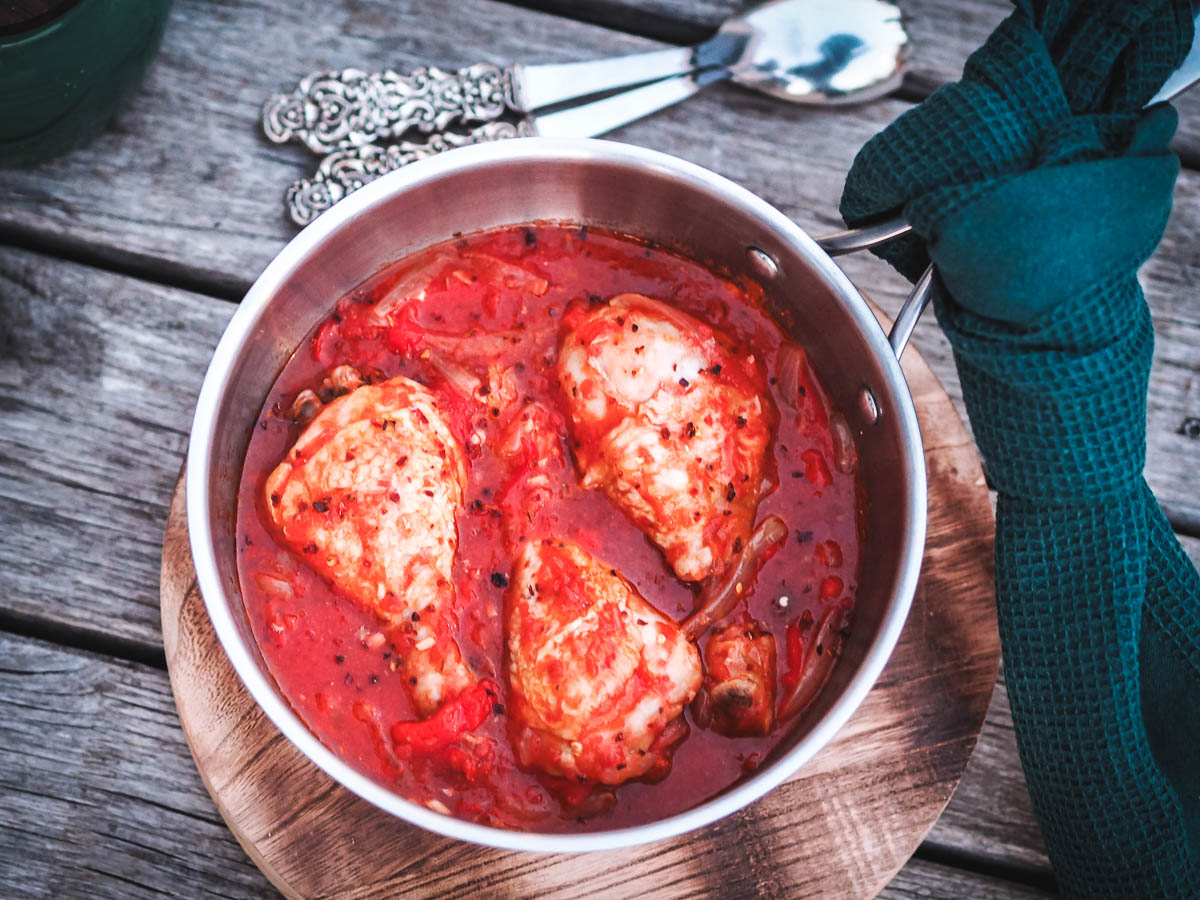
Real chicken basquaise from the Basque country is simply a piperade base in which pieces of chicken are cooked.
I brought you the real recipe for Basque chicken from my stay in the Basque country and my visit to the Espelette pepper basin and origin of this recipe, the Souletin country.
It was a little grandmother at a market who confirmed to me that my way of doing things corresponded to the traditional recipe.
Basquaise chicken is actually made with a piperade base : compote of tomatoes, sweet peppers (or peppers!) and onions that are simmered gently and to which we of course add the local queen spice: Espelette pepper AOP.
We can add eggs or Bayonne hame to make it a complete dish. Or chickenthis thus becomes this Basquaise chicken recipe. So it’s quite easy to do.

Use a whole chicken and ask your butcher to cut it into pieces.
A variation is to make the recipe with chicken thighs. Ideally thigh and drumstick, attached or separated.
If you use chicken breasts, be careful they cook a little faster.
The AOP AOC Espelette pepper is the only certified spice in France. Recognized controlled designation of origin (AOC in 2000 then Protected Designation of Origin (PDO) in May 2009 to comply with European standards.
The AOP Espelette pepper is cultivated in ten municipalities : Ainhoa, Cambo-les-bains, Espelette, Halsou, Itxassou, Larressore, Saint-Pée-sur-Nivelle, Souraïde and Ustaritz. The hills to the east and the ocean to the west create a particular microclimate, with abundant precipitation in spring and high temperatures in summer. The late season offers a mild climate, ideal for pepper growth and fruit ripening which takes place from September to October.
The AOP specifications are very strict. In particular, “the peppers must be harvested ripe, by hand, they must measure 7 to 14 cm and have a regular, conical shape and a smooth skin, when they are red. They must dry naturally for at least 15 days…”

Espelette pepper, hot spice with moderately intense spiciness (4/10 on the Scoville scale measuring the intensity of the spiciness of the peppers) is long in the mouth with great finesse and a persistent flavor.
I will soon prepare a complete article for you separately on the Espelette AOP pepper with lots of pretty photos from the Basque Country. Make sure you have the yellow and red AOP label on the jar you buy. Store it for a maximum of 2 years in a closed glass jar that is not too large.
It is not necessary to add the Espelette pepper from the start of cooking. Add it 5 to 10 minutes before the end.

I am using a sweet pepper mix from Aglet here since this recipe was made upon my return from a stay in the Basque country and I had brought some sweet pepper back in my suitcases.
In reality, the sweet pepper is absolutely not hot and is more like a kind of very fine pepper.
The difference is mainly in the thickness of the flesh rather than the taste.
Furthermore, a small seller on the Saint Jean Pied de Port market explained to me that there was no different variety of green and red sweet pepper but that it is about the degree of maturity, green at the beginning then red when fully ripe.
Also if you can’t find Anglet pepper or for convenience, you can definitely make your Basquaise chicken with red pepper and/or green pepper. 3 for this recipe, 2 red and 1 green.

Outside of tomato season, it is better to use canned tomatoes, either peeled tomatoes or cubed tomatoes (avoid in coulis, your sauce will lack a little consistency).
The period of peak tomato season is late spring, early summer. Depending on the earlier and later varieties, tomatoes are generally found on the shelves from May to September, sometimes a little earlier or later.
Outside of this season, either in autumn, winter and early spring, the tomatoes will either have grown in greenhouses or will be imported, or…?
In short, good canned tomatoes are better than tomatoes that are forced or have traveled the world and, what’s more, have no taste out of season.
In this recipe, I suggest you peel the tomatoes. This operation is optional but having tomatoes without skin will bring much more softness and creaminess to the sauce for your Basquaise chicken.

Bayonnaise chicken is what I understood to be a Basquaise chicken to which bacon or pieces of Bayonne ham are added. I’m going to dig into this.


Real Basque chicken is simply a base of piperade with pieces of chicken, without forgetting the Espelette pepper from the Basque country of course!
To prevent sleep
When serving, sprinkle with flat-leaf parsley and chopped spring onions.
Cooking can be done in the oven at 160°C.
Enjoy