Physical Address
304 North Cardinal St.
Dorchester Center, MA 02124
Physical Address
304 North Cardinal St.
Dorchester Center, MA 02124

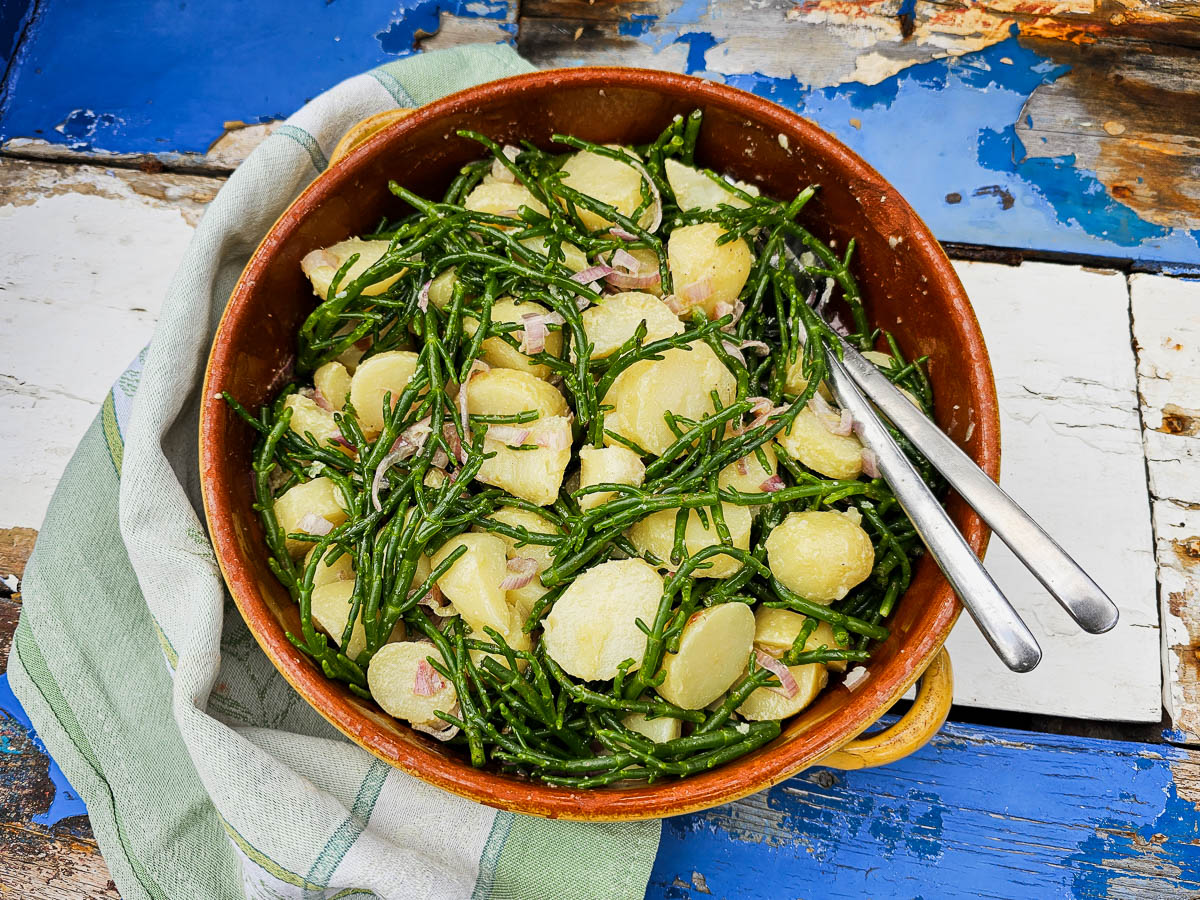
Salicornia in salad, crunchy with an iodized taste, to try with accompaniments and a very mustardy and lemony vinaigrette.
I explain to you what samphire is, what its health benefits are and how to consume it, raw or cooked.

samphire is also called sea bean, sea horn, sea pickle, false seaweed, stone pass-through…
Its name comes from the Latin salwhich means salt And horned for horn because of its stems which resemble animal horns.
The samphire is a halophilic plant which means “who loves salt”. This term is used for any plant living in contact with normally high concentrations of salt.
This wild plant grows by the sea or environment including salt water such as marshes, salt meadows covered with water during high tidal coefficients, estuaries…
Areas swept by high tides or salt marshes are naturally very rich in salt, more than the normal rate of the sea, due to evaporation increasing the salt concentration.
In Francewe find a lot of samphire in the Bay of Somme, Brittany, Vendée, Charente-Maritime, Gironde estuary.
But we can find them in places as surprising as Lorraine where resurgences of water passing through veins of salt remaining from a paleo-ocean create salt meadows. The land in certain places is still saturated with salt, creating water outlets at the resurgence points, creating salt marshes.
The samphire is an annual perennial plant originally from Europe ((Salicornia europaea) of the Chenopodiaceae family. It is therefore not not an algae but a plant that grows in salty environments.
Composed ofa fairly fleshy stem which is reminiscent of a fat flat and full of small branches, therefore without leaves. The flowers that appear in summer have no taste interest.
On the other hand, it is its adaptation to the salty environment which makes it a very interesting culinary plant. Indeed, to survive in the salty environment, the samphire stores the salt which it absorbs in the cells of its fleshy stems. This makes her a plant rich in sodium and with a pronounced salty taste.
The harvest is done at the end of spring and beginning of summerover a picking period which can go from May to August depending on the region.

The samphire is low calorieand has diuretic and depurative properties. It is also a valuable source of proteins, mineral salts and trace elements such as iron, potassium, calcium, magnesium, phosphorus, iodine. It is very rich in vitamins A, B and C., also in vitamin B12.
Be careful, however, to consume samphire in moderation because of their high sodium content. But as part of a diversified diet and without kidney problems or arthritis, a samphire salad does not cause any problems.

Raw or cooked, samphire can be eaten in many different ways:
Cooked: you can cook them in boiling water (unsalted) or steam, this will desalinate them a little. Salicornia cooks very well sautéed in a pan with butter and garlic for example. For cooking, it’s a bit like green beans.
With vinegar you can make homemade pickles, to serve like pickles.
We can dry samphire, which corresponds to an old way of consuming samphire. Dried then crushed, it serves as a condiment outside the harvest period, a flavor enhancer that can replace salt.
Believed in salad like here. You can definitely eat samphire raw. You will keep their crunchy side and their particular iodized taste without being too salty.
Raw samphire can be used as an accompaniment to fish for example.
Here I offer you a very simple recipe to serve as a starter with justboiled potatoes (small new potatoes or simply potatoes cut into pieces) and chopped shallots For make samphire the star of your salad
You can imagine a mixed salad with marine airs by adding seafood: mussels, peeled pink or gray shrimp, squid or even leftover cold fish.
And other vegetables of course: green beans, cherry tomatoes, cucumber…
As for the vinaigretteI chose it with enough mustard but not too acidic, therefore deliberately without vinegar: Dijon mustard, oil and a little lemon juice.


Salicornia in salad, crunchy with an iodized taste, to try with accompaniments and a very mustardy and lemony vinaigrette. I explain to you what samphire is, what its health benefits are and how to consume it, raw or cooked.
To prevent sleep
The main stages: we cook the potatoes in advance to let them cool. Then the recipe is simple, we make a vinaigrette, we rinse the samphire well, we slice the shallot, we peel and cut the potatoes. And we put everything together in a salad bowl. Serve as a starter like a mixed salad.
If you like culinary discoveries linked to the sea, I suggest you make a delicious seaweed tartare at home, with dried seaweed. It’s easy to make and so much cheaper homemade than buying in organic stores!